
Workforce data across global and Australian sources paints a clear picture of where jobs actually sit. Production and Manufacturing leads at 16%, followed by Health and Retail at 12% each, Education at 8%, Construction and Engineering at 7%, and Hospitality and Tourism alongside Public and Government at 6% each. Finance and Insurance and Transport and Logistics sit at 5%, with Agriculture and Food, Professional Services, and Arts, Media, and Culture each at 3%.
What’s easy to miss in a breakdown like this is that no sector operates in isolation. Retail alone depends on finance, IT, legal, logistics, and marketing all working together behind the scenes. Health, Education, and Construction are the same story: each one is really a dynamic ecosystem pulling in expertise from multiple disciplines, not a single specialised silo.
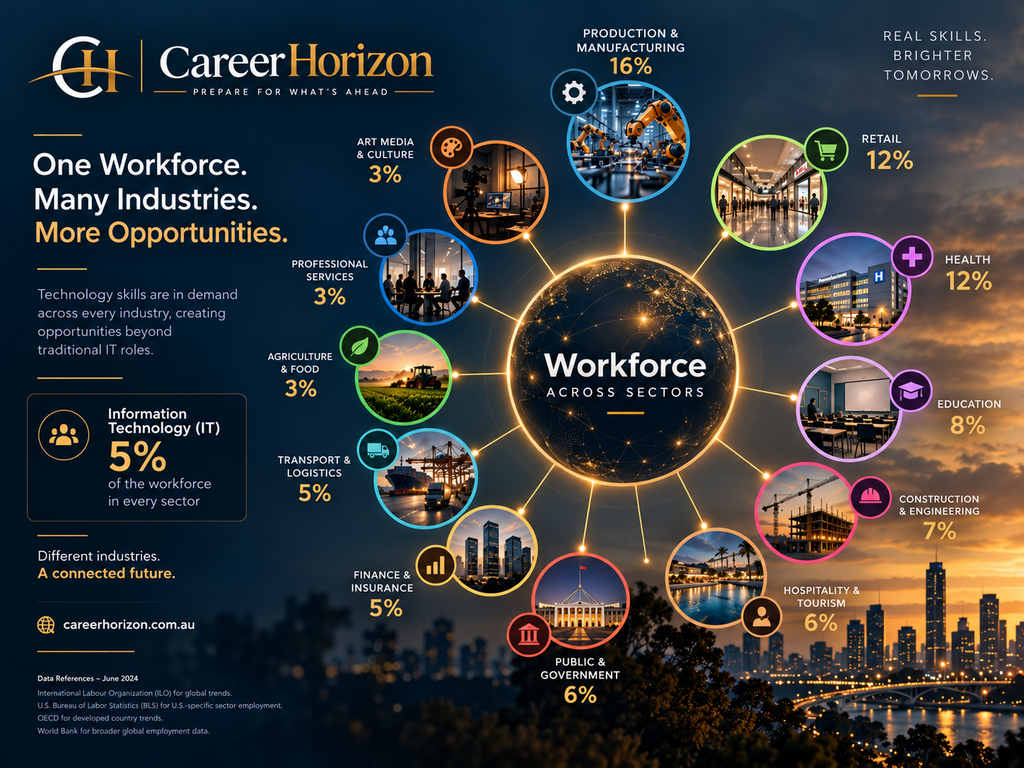
IT sits inside every one of these ecosystems. Across the data, IT staff consistently make up an average of 5% of the workforce in every single market sector, not just the sectors people typically think of as “tech.”
That number matters for anyone weighing a move into IT from somewhere else. If you’re currently working in manufacturing, health, construction, or almost anywhere else, IT isn’t a foreign industry you’d be starting from zero in. It’s already running quietly inside the sector you’re standing in right now, which means your existing industry knowledge is often a shortcut into IT, not a detour away from it.
Data references: International Labour Organization (ILO) for global trends, U.S. Bureau of Labor Statistics (BLS) for U.S.-specific sector employment, OECD for developed country trends, World Bank for broader global employment data. Compiled June 2024.