
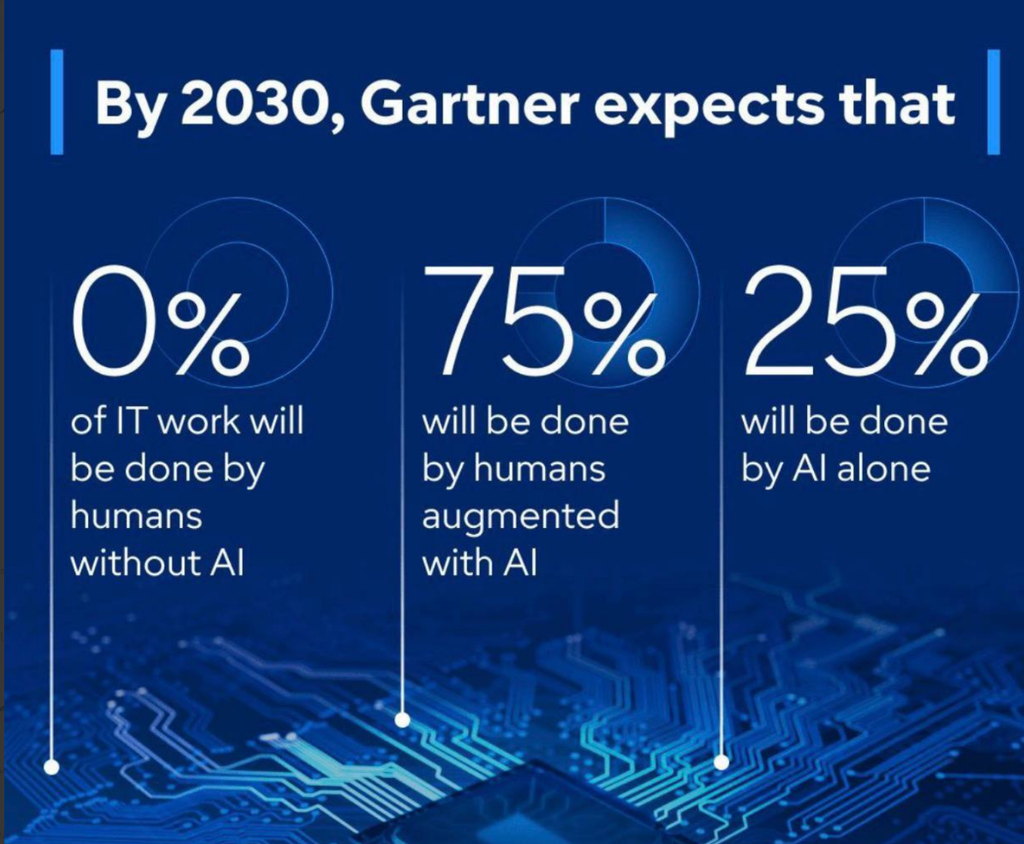
Gartner surveyed more than 700 CIOs at its IT Symposium/Xpo in October 2025, and the headline finding is striking: by 2030, no IT work will be done entirely without AI. Three quarters will be done by humans working alongside AI, and one quarter will be handled by AI on its own.
That statistic can sound alarming at first glance, but it’s worth reading closely. It doesn’t say a quarter of IT jobs disappear. It says a quarter of tasks shift to AI, while the vast majority of work still needs a human directing, checking, and applying judgement, just now with AI doing more of the heavy lifting underneath.
Gartner’s own analysts have been clear that this isn’t a story about mass job loss. Their research suggests AI’s impact on employment will stay neutral in the near term and turn positive within a few years, with hundreds of millions of new AI-supporting roles expected to emerge globally over the next decade as organisations restructure how work gets done.
What does change is which skills matter. Tasks like basic summarising, information retrieval, and routine translation are exactly the kind of work AI already handles well, so those specific skills carry less weight on their own. What replaces them is judgement: knowing when to trust an AI output, when to override it, and how to direct it toward the outcome a business actually needs.
This is precisely the shift Career Horizon’s Discover and Accelerator pathways are built around. The goal was never to teach people to compete with AI. It’s to teach people to be the ones AI works for.
Source: Gartner, “Gartner Survey Finds All IT Work Will Involve AI by 2030,” October 2025.